I know nothing about rugby. In 13 years of living in South Africa I’ve attended only one live rugby match. But I know a lot about sports and I know a lot about people. And I know that Saturday’s Rugby World Cup final between South Africa and New Zealand was something I’ve never seen before: An entire nation of 62 million people coming together – forgetting their gaping divides, forgetting their country’s problems and all the world’s problems – experiencing unadulterated joy while watching a sports team that belongs to all of them.
A Morning in Noordgesig
I recently connected with Fabian and Lavinia Otto during a Johannesburg Heritage Foundation tour of Coronationville and Bosmont. Fabian and Lavinia were our guides for the Coronationville/Bosmont tour but they actually live in Noordgesig, a historically coloured township on the northeastern edge of Soweto.
Read More
Asian Food Explorations in Rivonia
I’ve been meaning to write this blog post for weeks but I kept getting distracted by other adventures: a dazzling community light festival, a 2-billion-year-old meteorite crater, and a Heritage Month tour of churches. Now I’m back on track and ready to tell you about my food explorations in Rivonia.
Read More
The Spectacular Brixton Light Festival, Revisited
Last weekend I attended the Brixton Light Festival (hereafter referred to as the BLF) for the second consecutive year. I wrote a comprehensive post about the BLF last year, so in the days leading up to this year’s event I thought maybe I wouldn’t need to write another post. Ha! I was wrong.
Read More
Yola's: The Place for Koesisters (and Koeksisters?) in Joburg
I’m struggling to figure out how to start writing this post because I’m struggling to figure out how to explain koesisters.
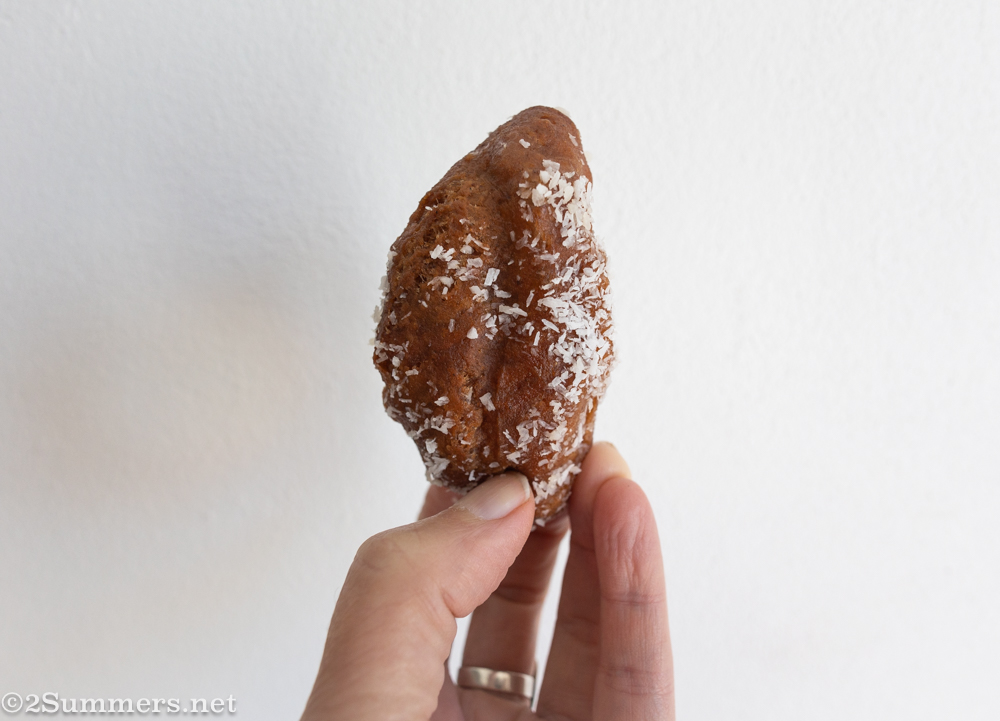
The koesister ranks among South Africa’s most iconic foods, right up there with biltong, boerewors, chakalaka, and milk tart. Koesisters are vaguely like donuts, just with a different shape, flavor, and texture. (So maybe not that much like donuts after all.) The koesister’s identity is further complicated by its close relationship to the koeksister – same word except with an extra k in the middle, but possibly stemming from an entirely different root – to which the koesister is similar, but different.